

Divorce changes nearly every part of your life.
Property is divided. Accounts are separated. Living arrangements change. Family routines are rewritten. Even the small things, like who handles the insurance or where important paperwork is kept, may suddenly look completely different.
Once the divorce is final, most people are ready to close that chapter and move forward.
Understandably, reviewing an estate plan is not always the first thing on the list.
But it should be near the top.
Many people assume that a final divorce automatically removes a former spouse from every will, trust, retirement account, insurance policy, power of attorney, and health care document.
That is a risky assumption.
Indiana law may affect certain provisions involving a former spouse, but the law does not sit down with you, review your new life, identify the people you trust now, and create a new plan that reflects your current wishes.
Only you can do that.
Failing to update your estate plan after divorce can lead to outdated beneficiaries, missing decision-makers, court involvement, and conflict among the people you care about most.
Even when the law prevents a former spouse from receiving something, the final outcome may still be very different from what you intended.
Your Will May Still Be Living in Your Former Marriage
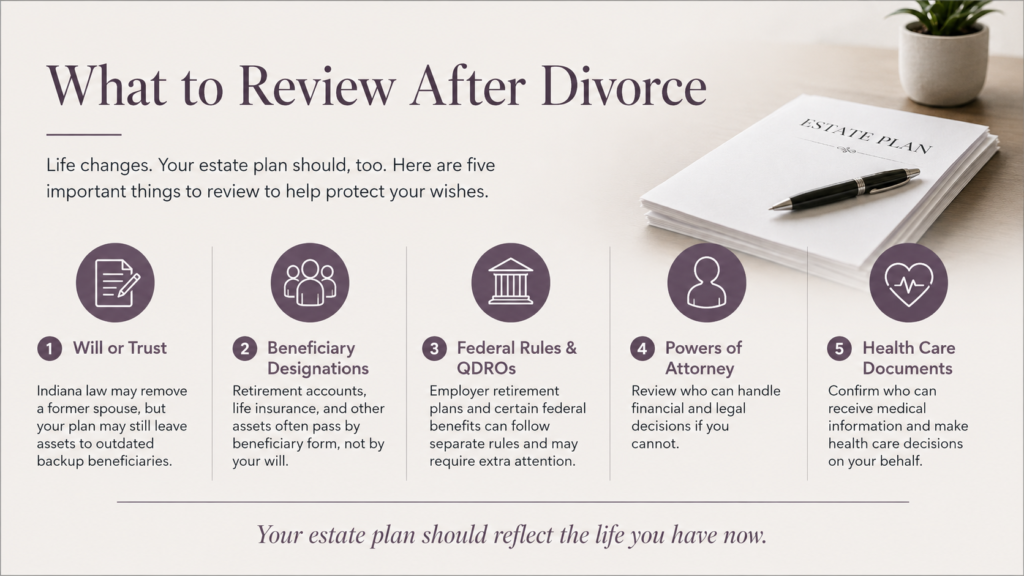
Under Indiana law, a divorce or annulment generally revokes provisions in a will that benefit a former spouse. However, the rest of the will may continue to operate.
At first, that may sound reassuring.
If the law removes your former spouse, why do you need to update the document?
Because the law does not decide who should take your former spouse’s place.
Your property could pass to an outdated backup beneficiary, a relative you are no longer close to, or someone you named during a completely different stage of your life.
Imagine that your will leaves everything to your spouse and names your sibling as the backup beneficiary. After the divorce, your former spouse may no longer receive that inheritance. If the will is never updated, your sibling could inherit everything, even if your intention was for the assets to pass to your children.
The law may prevent one unintended result while creating another.
That is not planning. That is hoping an old document somehow produces the right answer.
Updating your will or trust allows you to make deliberate choices instead of relying on outdated instructions and default legal rules.
Beneficiary Designations May Matter More Than Your Will
One of the most important things to understand after divorce is that your will does not control every asset you own.
Retirement accounts, life insurance policies, annuities, payable-on-death accounts, and transfer-on-death investment accounts typically pass according to the beneficiary form held by the financial institution or plan administrator.
These assets may never pass through your will.
That means you could sign a new will leaving everything to your children while an old beneficiary form still points in another direction.
Some beneficiary designations may be affected by divorce under applicable law. Others may be governed by federal law, the terms of a retirement plan, a divorce decree, or the contract itself.
This is not an area where you want to cross your fingers and assume everything worked itself out.
Contact every employer, insurance company, financial institution, and retirement plan administrator directly. Request confirmation of the current beneficiary and submit updated forms where appropriate.
At Norton Estate Planning & Elder Law, we remind families that changing a will does not automatically update every account connected to their estate plan.
Each piece must be reviewed and coordinated.
Federal Rules Can Create an Unwelcome Surprise
Employer-sponsored retirement plans and certain federal benefits can create additional complications because federal law may control who receives the account.
In some situations, the beneficiary form held by the plan administrator carries more weight than a new will, a family understanding, or what someone believes the divorce decree accomplished.
That matters because a retirement account may be one of the largest assets a person owns.
One outdated form can undermine the rest of an otherwise carefully prepared estate plan.
A divorce may also involve a Qualified Domestic Relations Order, commonly called a QDRO. A QDRO may divide an employer-sponsored retirement plan between former spouses.
However, dividing the account does not necessarily update the beneficiary designation for the portion you retain.
Those are two separate issues, and both need attention.
Your Former Spouse May Still Be Connected to Important Decisions
Estate planning is not only about who receives your property after death.
It also determines who may act for you if an illness, accident, or incapacity prevents you from making decisions.
A durable power of attorney allows another person to manage financial and legal matters on your behalf. If your former spouse was named as your agent, that document should be reviewed immediately.
Even when a divorce affects a former spouse’s authority, it does not automatically choose a new person to help you.
If your former spouse was your only agent and you never named a successor, you may be left without anyone who has clear authority to pay bills, communicate with financial institutions, manage property, or address urgent legal matters.
Your family could be forced to seek court involvement before they can help.
Health care documents deserve the same attention.
An outdated health care appointment or authorization may still identify the person you trusted during your marriage. That person may be authorized to receive medical information or participate in important decisions, depending on the document and surrounding circumstances.
Most people would not want an old document deciding who receives a call from the hospital.
Review your:
- Financial power of attorney
- Health care representative appointment
- HIPAA authorization
- Living will or advance directive
- Backup agents and decision-makers
These documents should reflect the people you trust today, not the relationships you had years ago.
Naming Your Children Directly May Create a New Problem
Parents often respond to divorce by replacing a former spouse with their children on every beneficiary form.
The intention makes perfect sense.
The result may not.
Minor children cannot independently manage a significant inheritance. If a child is named directly, a court proceeding may be necessary to appoint someone to manage the money.
The child may also receive complete control of the inheritance at an age you consider far too young to handle it wisely.
A properly drafted trust can provide more protection and flexibility. You can choose the trustee, establish how the money may be used, and decide when the child should receive control.
The trust may allow funds to be used for education, health care, housing, and other needs without handing an eighteen-year-old a large check and wishing everyone the best.
Naming children as beneficiaries is not the same as creating a complete plan for them.
Divorce Can Be the Beginning of a Blended Family
Many people eventually remarry after divorce.
A new marriage may bring stepchildren, additional children, separate property, shared assets, and a whole new set of family expectations.
An estate plan created during a previous marriage may address none of those realities.
It could unintentionally omit a new spouse, leave out a stepchild, or give one person control over assets that were intended for someone else.
Stepchildren generally should not be assumed to inherit automatically. If you want a stepchild to receive part of your estate, your documents and beneficiary arrangements should clearly reflect that intention.
Blended-family planning also requires more than writing everyone’s name on a list.
You may want to provide for a new spouse while preserving certain assets for children from your prior marriage. You may want your spouse to have access to property during life without allowing those assets to eventually pass outside your family.
Those goals can often be addressed, but they need to be addressed intentionally.
Without a coordinated plan, even people who genuinely care about one another can end up confused, hurt, and in conflict.
Review the Divorce Agreement Before Making Changes
Updating your estate plan after divorce is important, but you should not begin changing every beneficiary without first reviewing the final divorce documents.
A settlement agreement or court order may require you to maintain life insurance, preserve certain survivor benefits, complete a QDRO, or keep assets available to support a former spouse or child.
Changing a beneficiary in violation of those obligations could create serious legal and financial problems.
Your estate planning attorney should understand what the divorce agreement requires before helping you revise your documents and accounts.
The goal is not simply to remove your former spouse’s name.
The goal is to create a plan that reflects your current wishes while honoring any continuing legal obligations.
Your Estate Plan Should Reflect the Life You Have Now
Updating an estate plan after divorce involves much more than changing a few names.
It means reviewing who should inherit, who should manage your finances, who should speak for you in a medical emergency, how your children should be protected, and how your retirement accounts and insurance policies fit into the larger plan.
Your former estate plan was created for a life that has changed.
The people you trust may be different. The property you own may be different. Your responsibilities, relationships, and priorities may all be different.
Your plan should be different too.
Norton Estate Planning & Elder Law can help you review your will, trust, beneficiary designations, powers of attorney, and health care documents so they work together and reflect the life you are living now.
The most important question is not whether Indiana law automatically removes your former spouse from a particular document.
The question is this:
If something happened to you today, would your estate plan still reflect the people you trust and the decisions you would make now?
To update your estate plan after divorce, Request a Consultation.